



















The strategic advantage
Thriving leaders. Stronger cultures. Sustainable performance.
Leader wellbeing is the single strongest driver of organisational wellbeing. When organisations take it seriously, the results show up everywhere: in engagement, retention, trust, performance and the bottom line.
The proof
Taking leader wellbeing seriously pays dividends
Leader wellbeing is the single strongest driver of organisational wellbeing – 11x more impactful than employee stress-management programmes, and 4x more impactful than wellbeing apps.
Source: WorkWell Leaders & National University of Singapore, 2025
Managers account for roughly 70% of the variance in team engagement, across 183,806 teams and 3.3 million employees.
Source: Gallup, Harter et al., 2009
Our own benchmark data tells the same story. Among 3,342 leaders, those with high work wellbeing are far less likely to consider quitting (4.50 vs 2.56), carry much lower burnout risk (3.31 vs 2.00), and report significantly higher trust in their boss (4.37 vs 3.56) than leaders with low wellbeing.
Source: GLWS® dataset, 2026
Audrey McGibbon, 2025
Leader wellbeing is not merely a personal matter or HR concern. It is a strategic asset. When leader wellbeing improves, culture improves, engagement improves, retention improves and performance improves. The evidence is now too strong to ignore.”
Audrey McGibbon, CEO of Eek & Sense and author of the GLWS
Calculate the ROI to be gained
Model the ROI, payback period and total value GLWS could create for your own leadership team by investing in their wellbeing.
Your program
Set the size of your intended GLWS program, then choose an assumption level below.
Assumption level
Choose how confidently you want to model your GLWS program's effect, or fine-tune every assumption below.
Your GLWS investment for this group size has been automatically calculated using our published pricing, and is already factored into the results below.
Assumptions
Each field below feeds one part of the GLWS ROI formula. Please insert what you know (or estimate) to be true for the target group you intend to use GLWS with. Alternatively, you may stick with the default figures taken from published Australian workplace data, but these tend to be conservative and may understate the business case.
The average base salary of the target group.
The cost of sick days / unplanned leave per target group employee as a percentage of their salary.
How much of that absenteeism cost (above) the GLWS program could reasonably be expected to reduce.
Working while unwell or disengaged typically costs several times more than absenteeism. Default multiplier is 4x.
How much of that presenteeism cost the program is expected to prevent. 10% is the conservative default - evidence suggests it's often higher.
The share of this group likely to leave within 12 months without intervention. 12% is a conservative low-end benchmark - many sectors run at 20%+.
The cost of replacing one leaver - recruitment, onboarding, lost productivity - as a share of their salary. 30% is the low end of published estimates (up to 150% is common).
Of the leavers forecasted above (without this GLWS program), what share might you reasonably retain if this initiative is implemented?
The uplift in output per employee from higher wellbeing, converted to a share of salary. 10% reflects published research on wellbeing and performance.
Results
| Savings from reduced absenteeism (A) | $0 |
| Savings from reduced presenteeism (P) | $0 |
| Savings from reduced turnover (T) | $0 |
| Value of productivity increase (I) | $0 |
| Total value created (A+P+T+I) | $0 |
Total value created
$0
ROI
0%
Payback period
-
time for value created to cover the investment
*C is inclusive of all GLWS product, administration and reporting costs, but excludes any consulting, coaching or FTE costs that may be needed for program or project design and deployment support. Even allowing for those additional costs, the program is likely to more than pay for itself.
Get the evidence brief
See the full evidence chain and GLWS benchmark data behind these numbers.
The wake-up call
The overlooked struggle of leaders
Leaders (and most senior professionals) operate under intense scrutiny and pressure, navigating complex decisions, managing diverse teams and responding to constant change. Like all employees, leaders also have human vulnerabilities, wellbeing and mental health needs.
The overlooked struggle
1 in 4 leaders report mentally struggling at work – a figure rising by an average of 27% every year since 2020.
GLWS data (2026)
What we’re seeing
High workloads, scarce resources and poor work-life balance are significant strains on leaders’ health, increasing their risk of stress, anxiety, burnout and depression.
Across our benchmark data, leaders and managers report meaningfully lower wellbeing than individual contributors (3.78 vs 3.63 vs 3.49 at work) – and the gap widens further for anyone carrying people-leadership responsibility (3.43 vs 3.65 at work for those who don’t manage others).
Source: GLWS dataset, 9,986 professionals, 2026
The result
Six findings are driving the gap and decline in leader wellbeing: more work-life boundary violations, more work spilling into personal life, higher burnout risk from workload, more distraction by work during family time, workdays that feel like a race against the clock, and higher work-related stress and anxiety.
Levels of worry, stress, anger, sadness and loneliness are highest among leaders. Left unaddressed, this drives talent out, increases psychosocial risk and undermines organisational performance.
The solution isn’t asking individual leaders to become more resilient. It’s redesigning how leadership itself is resourced, supported and sustained.
You can't outperform your wellbeing
It’s an emerging fundamental fact: a leader’s wellbeing isn’t separate from their performance, it’s the foundation of it.
Yet today’s leaders operate in a state of semi-permanent disruption and hyper-alertness, that brings with it a high need for adaptation and risks of cognitive overload, fatigue, stress and anxiety. Leading effectively in a Volatile, Uncertain, Complex and Ambiguous (VUCA) world requires Vision, Understanding, Clarity and Acceptance – adaptability and sound judgement, but these capacities are contingent on maintaining adequate baseline wellbeing.
No matter how talented they are, a depleted leader simply can’t sustain the performance levels demanded of them. Wellbeing isn’t a desirable personal extra. It’s the foundation beneath every leadership capability organisations depend on:
Self-awareness —
leaders who are accurately attuned to their own skills, feelings, values and habitual patterns of behaviour, make sharper decisions, foster stronger relationships and lead psychologically safer teams (the “leadership superfood” of the 21st century).
balancing sincere concern for others alongside task and outcome accomplishment, effective leaders demonstrate genuine support through curiousity, listening and tangible action.
leaders who build deep, trusting relationships are the only ones who can create the necessary foundations for psychological safety and high-performing teams.
Courageous conversations —
leaders who navigate challenging discussions and address conflict openly and respectfully, role-model healthy organisational tension and create the constructive dynamics required for success.
Adaptability —
continually recalibrating in the context of constant change, leaders with high adaptability demonstrate psychological and cognitive flexibility and growth mindsets, enabling more effective leadership through uncertainty.
Systems thinking —
leaders who understand the interconnected nature of people, work and organisational systems are better able to build collective capability, strengthen resilience and create sustainable performance outcomes.
And the business impact is measurable. Organisations that prioritise the psychological safety and wellbeing of their leaders report 20% higher employee engagement, 27% lower turnover, and significantly stronger financial performance.
The cost of ignoring it is just as measurable: 50% of workers are now at risk of burnout — a clear signal of high psychosocial risk, low wellbeing and compromised productivity.
And as an investment, the maths is also clear: every $1 invested in mental health at work returns around $4 through improved productivity and reduced compensation claims.
Audrey McGibbon, 2025
“High levels of personal wellbeing are a prerequisite to meeting and mastering the expectations of contemporary leadership.
Which raises the question every organisation eventually has to face: if leaders are the foundation, what happens when the foundation itself is under strain?“
The leadership wellbeing shadow
Every leader casts a shadow – through what they say, do, prioritise and measure, whether they intend to or not.
It shapes how their teams think, feel and behave more powerfully than any strategy document or policy.
A well-resourced leader casts a positive one: their team feels safer, trusts more, and performs better.
A depleted leader casts the opposite – even with the best intentions.
Improving leaders’ wellbeing and improving wellbeing leadership are inseparable. Leaders cannot sustainably create for others what they do not experience themselves.
Get the research brief
See the full data – by seniority, by management responsibility – and the six drivers behind the gap.
The fix
The leader wellbeing blueprint
Leadership wellbeing is a complex, systemic challenge – but it is measurable and actionable. Once you can see the drivers and their magnitude, it stops being a soft issue and becomes something you can manage.
The most effective HR leaders reframe the wellbeing of their leaders and key talent groups into three practical levers the business already understands:
- Demand – what leaders are being asked to carry
- Resources – what sustains them
- System – how culture, rhythms and processes amplify or reduce the pressure
Addressing all three means:
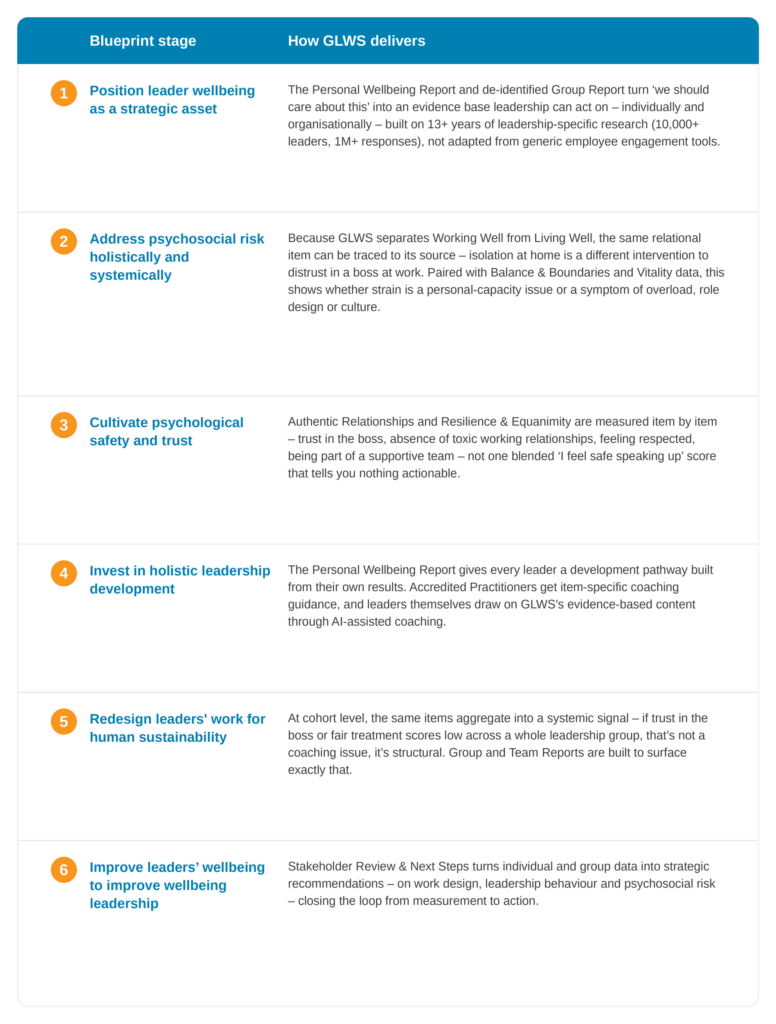
- Position leader wellbeing as a strategic asset
- Address psychosocial risk holistically and systemically
- Cultivate a leadership culture of psychological safety and trust
- Invest in holistic leadership development
- Redesign leaders’ work for human sustainability
- Improve leaders’ wellbeing to improve wellbeing leadership
Every stage above starts in the same place: knowing where your leaders actually stand.
That’s why measurement is the foundation of every effective leader wellbeing strategy. Here’s how the GLWS system delivers against each one:
Get the full leader wellbeing blueprint guide
The six-point blueprint, how GLWS delivers against each stage, and the proof it works. Includes a real case study: how a 27-person extended leadership team under sustained regulatory pressure, used GLWS data to turn a people-risk issue into a measurable, proactively-owned action plan.
From blueprint to action
The evidence is clear: organisations that treat leader wellbeing as the strategic asset it is outperform those that don’t – in culture, in capability, and in results.
Every organisation’s starting point is different. The GLWS System is how we help you find yours.
Your data, handled with care
Every GLWS response is handled with the same rigour we bring to the assessment itself – confidential, secure, and never identifiable at an individual level other than for the individual themselves.
See what good practice looks like
Read how these organisations are putting leadership wellbeing into practice — and the difference it’s making for their leaders, teams and results.