Over the past decade, understanding of wellbeing in the workplace has evolved significantly. We’ve observed four key trends:
- A growing awareness about holistic wellbeing and the opportunity it offers individuals as a lever to prevent burnout, sustain energy and perform at our best.
- Increasing leadership recognition of the link between wellbeing (especially for leaders themselves) and business performance.
- Rising scepticism toward wellbeing-washing and well-intentioned yet tokenistic, one-size fits all interventions that over time have proven to do little but waste time and budgets.
- Evidence (research and practical) from progressive leaders and organisations who have embedded structured wellbeing assessments and purposefully integrated wellbeing into their talent strategies. Such organisations have reaped the benefits, realising positive knock-on effects which delivered ROIs to the business of up to 975%.
High wellbeing is good for business
While you won’t see ‘Employee Wellbeing’ neatly on a balance sheet, poor mental health and low wellbeing costs organisations dearly, with substantial evidence showing direct lost costs via:
 Reduced productivity
Talent loss and turnover
Absenteeism
Presenteeism
Workplace stress
Lower job satisfaction and engagement
Conversely, organisations that prioritise employee well-being report significant business benefits:
 Increased Productivity: Employees who are satisfied with their jobs and wellbeing are 12% more productive than those who are dissatisfied.
Higher Profitability: Higher levels of employee wellbeing are linked to higher business valuations, return on assets, and profits.
Reduced Turnover: which in turn reduces recruitment and training costs.
Enhanced Customer Satisfaction: Happy employees are more likely to provide better customer service, leading to higher customer satisfaction and loyalty.
Compliance and Risk Management: With increasing regulations focusing on psychological health and safety at work, neglecting employee wellbeing can pose significant risks to businesses.
In short, investing in employee wellbeing is not just a moral imperative – it’s a strategic lever.
But how do organisations reliably achieve these gains?
Welbeing needs a framework
Securing positive results – for both individuals and the business – is most reliably and efficiently achieved when a framework and methodology are used that allow measurement and identification of the explicit wellbeing threats impacting on individuals and the business. This enables action to be taken to address the threats, plug the lost costs and realise the gains.
How do successful organisations measure and influence wellbeing?
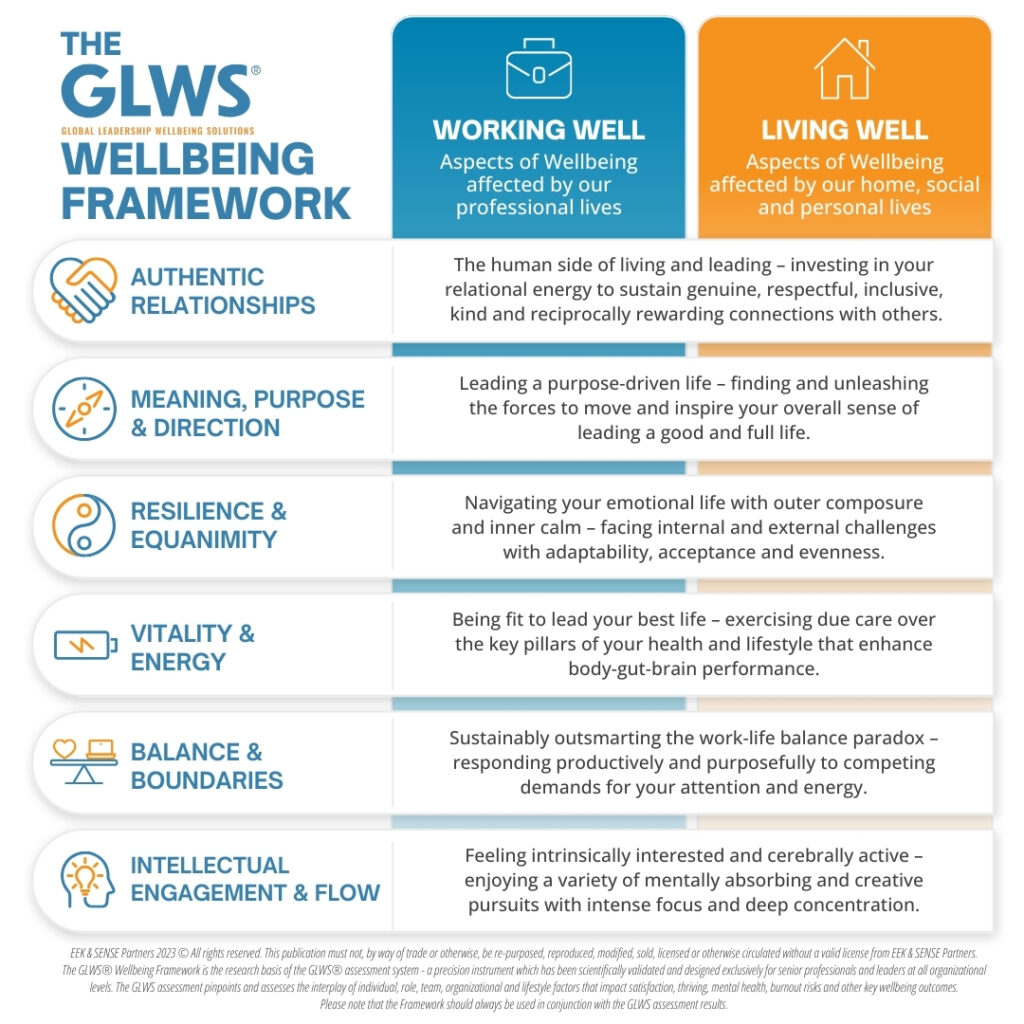
Over a decade of research and validation with leaders has led to this – a complete, holistic model of the dimensions of professional and personal thriving – the GLWS Wellbeing Framework.
Just as a physician conducts a diagnosis before treatment, or a training needs analysis precedes program development, wellbeing requires a framework for effective assessment and diagnosis.
The GLWS Wellbeing Framework is a validated, scientific model of wellbeing that defines the factors enabling people to thrive both professionally and personally.
It defines 6 unique dimensions of wellbeing, providing a model by which individuals, teams, and organisations can:
- Measure current wellbeing status
- Identify strengths and threats
- Develop targeted interventions n to improve wellbeing and performance
Independent research by the University of Melbourne (2023) involving 6,500 professionals, leaders, executives and managers, has validated the GLWS Framework, confirming that the six GLWS dimensions determine overall wellbeing, happiness and satisfaction in life and at work.
The GLWS Wellbeing Framework in action
The GLWS Wellbeing Framework is more than a conceptual model. The power of the GLWS Wellbeing Framework is accessed via the GLWS Assessment System, used by Coaches and organisations to:
- Diagnose the root causes of wellbeing risks and opportunities
- Understand how individual, team, leadership, organisational and lifestyle factors intersect
- Drive meaningful, systemic improvements in work design, culture, processes and practices
The GLWS gets to the heart of the factors known to drive and sustain the wellbeing of senior professionals and leaders, both at an individual and systemic level. It assesses how individual, leader, team and organisation factors all contribute – because Wellbeing is a shared responsibility.
The true power of the GLWS comes from an approach that detects and diagnoses what must happen within the organisational and leadership system collectively to improve work design, culture, processes and practices while simultaneously enabling and promoting positive change individually.