
Last month I had the privilege to attend the Corporate Mental Health Australia (CMHAA) Annual members gathering, where Kate Connors and I facilitated two workshops with over 50 Australian employers to examine the psychological health and functioning of leaders in the workplace today.
The workshops aimed to explore:
- WHY leaders’ wellbeing is a priority for the corporate mental health agenda, and
- HOW employers can assess and develop their leaders‘ wellbeing — sensitively, accurately and efficiently for positive change, both individually and collectively.
Discussions quickly highlighted the existence of several psychological and organisational complexities, which I have summarised for CMHAA members in a special edition GLWS & CMHAA Insights Paper which you can download in its entirety below.
Top 5 Headlines from the workshops
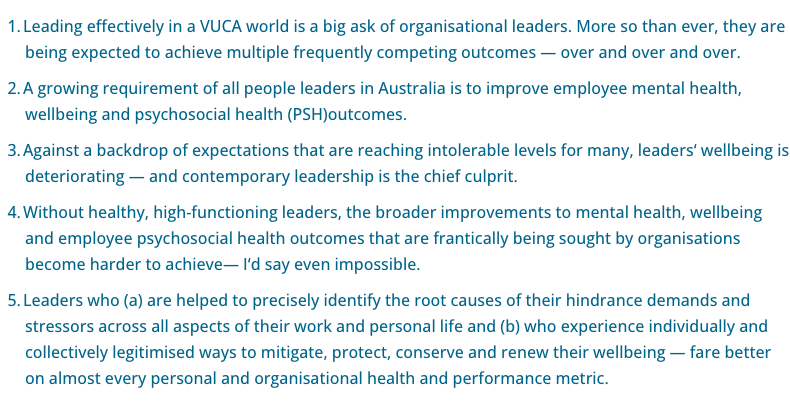
Two core needs were identified:
- Address a significant pain point – employers realise their leaders are humans and not machines, nor immune to fatigue, stress and overwhelm. Yet leaders’ work-related wellbeing is becoming a major source of strategic, operational and ethical concern. Leaders need more (good/appropriate/timely) support to reach and stay at their best.
- Unlock a competitive lever – improving leaders wellbeing has a compelling impact on the bottom line. Healthy, high-functioning leaders deliver better team and organisational results.
From this, there were 2 main calls to action:
- Engage leaders and senior professionals early and regularly. Implement a streamlined, unobtrusive, and swift digital experience. Ensure the approach resonates with even the most discerning, perceptive, time-constrained, and senior professionals. Engage your critical talent cohorts early and frequently in identifying the various stressors and protective factors in their work and personal lives. Emphasize the importance of individual responsibility and agency in assessing how these factors uniquely combine to enhance or potentially harm their functioning and wellbeing.
- Augment individual interventions with a systemic lens. Apply an organisational, systemic lens to supplement individual interventions. Leverage aggregated and cohort-specific health, wellbeing, and performance data to identify, target, and monitor ‘hot spots’ within the system, culture, processes, and mechanisms that require a collective response to make change possible.
I want to say a huge thank you to CMHAA for providing this opportunity and to everyone who participated in the workshops and shared their experiences, challenges and opportunities for action — I hope you found the experience as energising as I did.